
Pro Tennis Nets Guide: Quality and Longevity
A sagging, sun-bleached net doesn't just ruin the look of your court; it fundamentally breaks the game. You've likely dealt with the frustration of a headband that frays after a single summer or a net that refuses to hold its tension no matter how hard you crank the winder. It's disheartening to see your equipment rot under high UV levels when you just want to focus on your serve. We understand that a tennis court is a significant investment, and the hardware should reflect that quality.
This guide helps you discover how to select high-performance tennis nets that withstand the harsh New Zealand elements and keep your court in top-tier condition. You'll gain the confidence that your gear meets official tournament specs while requiring minimal maintenance. We'll break down the essential features of professional-grade netting, from mesh thickness to weather-resistant headbands, so you can spend less time fixing gear and more time playing the sport you love. Whether you're managing a local club or upgrading your home court, getting the details right ensures your setup looks professional and performs brilliantly for years to come.
Key Takeaways
- Learn how mesh thickness and double-mesh top rows prevent ball bleed-through and protect high-impact zones from premature wear.
- Discover how to choose the right tennis nets for your facility, from permanent club fixtures to versatile mobile systems for multi-sport centres.
- Master the "Goldilocks" approach to net tensioning to ensure professional playability while protecting your court hardware from unnecessary stress.
- Identify the high-quality, UV-resistant materials that prevent rotting and fading to keep your court looking sharp through every Kiwi summer.
- Gain practical maintenance tips that maximise your equipment's lifespan and ensure it consistently meets professional tournament specifications.
Why a Professional Tennis Net is a Vital Court Investment
A tennis net isn't just a barrier; it's the heartbeat of the court. While it's tempting to view all tennis nets as equal, the difference between a recreational mesh and a professional-grade setup is immediately obvious once the first ball is struck. Investing in high-quality equipment transforms a basic playing surface into a high-performance facility. It's about more than just looks. It's about the physics of the game. Professional nets are designed to meet Official court and net dimensions while providing the structural weight needed to stop a 150km/h serve in its tracks.
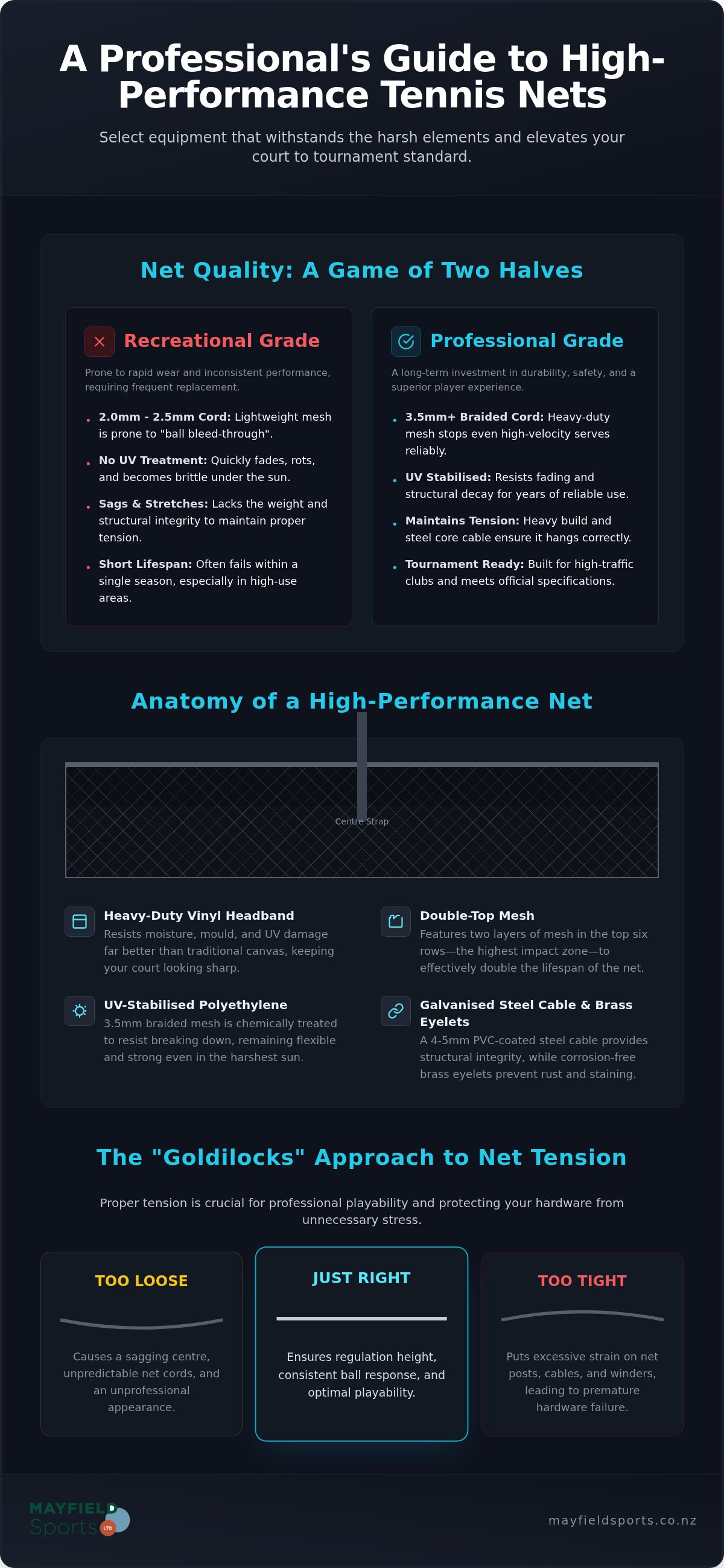
The most significant differentiator is the mesh thickness. Recreational nets often use lightweight 2.0mm or 2.5mm cord. These are prone to "ball bleed-through," where high-velocity shots can actually squeeze through the mesh. Professional options typically feature 3.5mm braided polyethylene. This added weight ensures the net hangs correctly and absorbs impact without stretching or tearing. Over time, the durability of these materials pays for itself. In New Zealand's harsh UV environment, a cheap net might fade and rot within a single season. A professional-grade investment stays black, strong, and reliable for years.
The Impact on Player Experience
Every player deserves a court that feels tournament-ready. When a net sags or the headband starts to fray, it creates a visual distraction that pulls focus away from the match. Consistency is the key here. A professional net maintains its height and tension throughout a long afternoon of play, ensuring that a ball clipping the tape behaves exactly as expected. It builds confidence. It encourages better play. By removing the annoyance of a sloppy, sagging centre, you create an environment where the game remains the sole priority.
Safety and Structural Integrity
The hidden strength of a professional net lies in its internal cable. High-tensile steel cables are essential for maintaining the "Goldilocks" tension required for elite play. Without this internal backbone, a net will inevitably bow in the middle, making it impossible to meet regulation standards. This structural integrity also serves as a safety feature. You don't want a cable snapping under tension or a net failing during a high-energy doubles match. A robust net stays taut regardless of the weather, resisting the wind and rain that often plague outdoor courts across the country.
Understanding Net Construction: Mesh, Headbands, and Cables
Building a court that lasts requires looking beyond the surface. When selecting tennis nets, the quality of the construction determines whether you'll be replacing it next season or enjoying it for a decade. The core of any net is the mesh. Thickness is non-negotiable for serious play. While a 2.5mm mesh is common for casual backyard use, professional facilities opt for 3.5mm braided polyethylene. This thicker cord provides the weight and density needed to absorb high-impact energy without deforming.
In New Zealand, UV stabilisation is the silent hero of court longevity. Our sun is notoriously harsh on plastics. Without specific UV-treatment, polyethylene becomes brittle and "chalky" within months. High-performance nets are chemically stabilised during the manufacturing process to resist fading and structural breakdown. This ensures the net remains flexible and strong even in the height of summer. Pair this with a heavy-duty vinyl headband, which resists moisture and mould better than traditional canvas, and you have a net built for the long haul.
Single vs Double Mesh Explained
Most wear happens in the top six rows of the mesh. This is where the ball hits most frequently during serves and volleys. A "double-top" design features two layers of mesh in this high-impact zone. It effectively doubles the lifespan of the net by reinforcing the area most prone to fraying. For clubs and high-traffic schools, this isn't just an upgrade; it's a necessity for smart budget management. While a single mesh is fine for a private home court with light use, double-mesh rows provide that tournament-grade resilience every club needs.
Hardware: Cables and Eyelets
The internal cable is the net's backbone. Professional nets use 4mm or 5mm galvanised steel cables, often coated in PVC to prevent friction against the headband. This coating is vital. It stops the steel from sawing through the fabric during tensioning. Look for brass eyelets at the corners. Unlike steel eyelets that eventually rust and stain the net, brass remains corrosion-free in coastal New Zealand environments. These small details ensure your gear remains compatible with standard court winders without seizing up.
Choosing the right combination of materials ensures your court remains a professional-grade asset. If you're ready to upgrade, you can explore professional court hardware to find the perfect fit for your facility.
Selecting the Right Net for Your Court Environment
Every court has its own personality and its own set of challenges. A sheltered backyard court faces different environmental stresses than an exposed facility sitting on a windy coastline. When you're choosing tennis nets, you have to look beyond the mesh and consider the physical space. The frequency of play is your primary guide. A school court that sees action six hours a day requires a heavy-duty net, whereas a private home court might prioritise a balance between professional aesthetics and ease of seasonal maintenance.
High-traffic facilities should always opt for the heaviest gauge hardware available. Constant impact from high-velocity serves and the friction of players brushing against the net will quickly degrade inferior gear. For dedicated tennis centres, permanent net posts with internal winding mechanisms are the gold standard. They provide the most stable platform for high-tension play. However, if your facility needs to be more agile, there are professional alternatives that don't sacrifice playability for portability.
Mobile Systems for Flexible Spaces
Shared sporting spaces, such as multi-sport school halls or community centres, often need to clear the floor for basketball, netball, or assemblies. This is where a professional tennis mobile system becomes a game-changer. These aren't flimsy, lightweight toys. A pro-grade mobile system features a heavy-duty steel frame and high-quality castors that allow a single person to wheel the entire unit into storage. The secret to a good mobile setup is the base. Look for wide, weighted ends that won't "creep" toward the centre of the court when the net is fully tensioned. When you're done for the day, always remember to slightly back off the tension before moving the unit to preserve the life of the internal cable.
The Role of Tennis Windbreaks
In many parts of the country, the wind is just as much of an opponent as the person across the net. Integrating tennis windbreaks into your court fence is a strategic move that protects more than just your ball toss. These mesh screens act as a structural shield for your net. By diffusing the force of lateral gusts, windbreaks reduce the constant "tug-of-war" stress on your net posts and the net's internal cable. This simple addition can significantly extend the lifespan of your court hardware. Beyond durability, they provide a dark, consistent background that makes the ball much easier to track, creating a focused, professional atmosphere for every match.
Installation and Maintenance: Getting the Most Out of Your Investment
Buying high-quality tennis nets is only half the battle. The way you install and care for your equipment determines whether it lasts for a decade or fails after a few seasons. Proper setup isn't just about aesthetics. It's about mechanical sympathy. When a net is hung correctly, the tension is distributed evenly across the posts, the internal cable, and the headband. This prevents the premature fraying and structural warping that often plagues DIY installations. It's the difference between a court that feels like a professional club and one that feels like a backyard afterthought.
How to Install Your Tennis Net Correctly
Start by laying the net across the court. Thread the internal cable through the post caps and attach the loop to the dead-end post. On the winding post, ensure the cable is seated correctly in the internal winder mechanism. Before you apply full tension, centre the net perfectly. Use lacing bars or cord to secure the side of the net to the posts. This keeps the edges tidy and prevents the net from blowing out of alignment during play. Finally, attach the centre strap. Adjust it until the net measures exactly 0.914 metres at the centre, as per official regulations. This ensures the "Goldilocks" height: not too high to block a good shot, and not too low to be unfair.
Tensioning requires a delicate touch. You want the top cable to be taut enough to provide a straight line, but don't over-crank the winder. Over-tensioning is a leading cause of post-failure and cable snaps. If the posts start to lean inward, you've gone too far. Aim for a firm, stable top line that doesn't bounce excessively when a ball clips the tape.
Extending the Life of Your Net
New Zealand's coastal environment presents unique challenges. Salt spray can be incredibly corrosive to even the best galvanised hardware. If your court is near the ocean, rinse the headband and cable ends with fresh water every few months to remove salt deposits. This simple habit prevents the "crusty" buildup that leads to cable failure. Keep an eye out for UV damage. If the mesh starts to feel brittle or leaves a black residue on your hands (known as chalking), it's a sign that the structural integrity is fading. Small frays in the mesh can often be repaired with high-strength twine, but once the headband starts to rot or the internal cable shows signs of rust, it's time for a replacement.
If your current setup is showing its age and no longer holds its tension, you can buy professional-grade tennis nets online for national delivery across New Zealand.
Elevate Your Game with Mayfield Sports Hardware
Mayfield Sports isn't just another generic sports retailer. We are dedicated specialists who focus on the hardware that keeps your game moving. Our equipment is curated specifically for the unique demands of the New Zealand climate, ensuring that whether your court is battered by coastal winds or baked in the intense inland sun, your gear remains up to the task. We understand that a net is a central part of your facility's infrastructure, not just an accessory. By choosing a specialist provider, you're ensuring that every component of your court has been vetted for quality and performance.
Our commitment goes beyond simply selling products; we aim to be a partner in your sporting journey. Because we specialise in court hardware, we offer a level of technical insight that generalist stores can't match. We understand the specific requirements for different levels of play, from casual community matches to high-stakes tournament finals. This focus on professional-grade materials, like the UV-stabilised netting and robust hardware discussed earlier, ensures that every club, school, and homeowner receives equipment designed for maximum longevity. We pride ourselves on being the knowledgeable local experts you can trust to get the details right, helping you avoid the common pitfalls of inferior recreational gear.
The Mayfield Specialist Advantage
Supporting the growth of tennis and pickleball across the country is at the heart of what we do. We don't just supply gear; we provide the foundation for better play and stronger communities. Our range of professional-grade equipment is built to meet official standards, giving players the confidence that they are training and competing on a tournament-ready surface. This dedication to excellence is why we are trusted by clubs and schools nationwide to provide the hardware that stands up to the rigours of daily use and the harsh southern elements.
Ready to Upgrade Your Court?
Finding the right equipment shouldn't be a hurdle. Our online store makes it simple to browse our full range of tennis nets and court accessories from anywhere in the country. We provide efficient national delivery, ensuring that even the most remote facilities have access to tournament-standard gear. Our logistics network is designed to handle the size and weight of professional hardware, getting your new setup to your gate without the stress. If you are managing a larger project, such as a multi-court club upgrade or a school facility overhaul, our team is available to provide tailored advice and coordinate bulk orders to suit your specific timeline and budget requirements.
Take the next step in improving your facility today. View our professional tennis nets and court hardware to explore the full range of specialist equipment. We are ready to help you create a court that looks professional and performs brilliantly for years to come. Whether you're starting a fresh build or replacing a worn-out net, we provide the tools you need for sporting excellence.
Build a Court That Performs
A high-performance court is only as good as the hardware that anchors it. By selecting tennis nets with 3.5mm braided mesh and UV-stabilised headbands, you're doing more than just buying equipment. You're ensuring that every serve, volley, and match-point happens on a surface that meets professional standards. The right installation and consistent maintenance are the secrets to making your investment last through years of intense play and harsh weather. It's about creating an environment where the game is the only focus.
Mayfield Sports stands as your specialist court hardware expert. We provide high-tensile, UV-stabilised materials that are trusted by clubs and schools nationwide. Trusted by clubs. Built for longevity. Ready for the first serve. We're here to help you get the details right so you can focus on the game. Whether you're upgrading a local club or a private home court, we have the professional gear you need to succeed. Take the next step toward a tournament-ready setup today.
Upgrade your court with professional tennis nets today and experience the difference that quality hardware makes. See you on the court!
Frequently Asked Questions
What is the standard height of a tennis net at the centre?
The official height of a tennis net is exactly 0.914 metres at the centre point. To achieve this regulation standard, you must use a centre strap to pull the net down to the correct level. At the net posts, the height should be 1.07 metres. Maintaining these precise dimensions is essential for fair play and ensuring your court meets official specifications for both recreational and competitive matches across New Zealand.
How do I know if my tennis net needs replacing?
You'll know it's time for a replacement if the mesh feels brittle or leaves a black residue on your hands, which is a clear sign of UV breakdown. Other warning signs include a frayed headband that no longer protects the internal cable or a net that sags despite your best efforts to tension the winder. If the internal steel cable shows rust or the mesh has multiple large holes, it's definitely time to upgrade.
Can I use a tennis net for pickleball?
It's not recommended because the dimensions and requirements are fundamentally different. A standard tennis net is 12.8 metres long and 0.914 metres high at the centre, while a pickleball net is shorter at 6.7 metres and lower at 0.86 metres. Additionally, the mesh on tennis nets is often too large for pickleball balls, which can get stuck or pass through. For the best game experience, it's better to use dedicated pickleball nets.
What is the best material for a tennis net headband?
Heavy-duty, UV-stabilised vinyl is the superior choice for headbands in the New Zealand climate. Unlike traditional canvas, which can absorb moisture and develop mould, vinyl is easy to clean and resists the harsh southern sun. A high-quality vinyl headband also provides better protection for the internal cable, preventing friction that leads to snaps. Look for multi-layered stitching to ensure the headband stays securely attached to the mesh during high-impact play.
How do I prevent my tennis net from sagging?
Preventing sag starts with a high-tensile galvanised steel internal cable and a professional-grade winding mechanism. You should tension the net until the top line is straight, then use a centre strap to lock in the official height. Avoid over-cranking the winder, as this can damage the posts or snap the cable. Routinely checking the tension after heavy use or extreme temperature changes will keep your net looking sharp and playing correctly for every match.
Are professional tennis nets weather-resistant?
Professional nets are specifically engineered to withstand outdoor elements like rain and intense sunlight. High-quality tennis nets feature UV-stabilised polyethylene mesh that won't rot or become brittle after a single summer. Using corrosion-resistant hardware, such as brass eyelets and PVC-coated steel cables, further protects the system from rust. While they are built for durability, rinsing off salt spray in coastal areas will help extend their lifespan even further by preventing corrosive buildup.
How long should a high-quality tennis net last?
A professional-grade net should typically last between five and ten years, depending on the frequency of play and the local environment. In high-traffic clubs, you might see more wear in the top rows, while private courts might enjoy a longer lifespan. Factors like UV exposure and salt air can accelerate aging, but choosing heavy-duty materials and following a basic maintenance routine will ensure you get the maximum value from your investment over time.
What is the difference between single and double mesh?
The main difference lies in the reinforcement of the high-impact zone. A single mesh net has a consistent thickness throughout, whereas a double-mesh net features extra layers in the top six rows. This is where most balls hit the net during play. By doubling the mesh in this area, you significantly reduce the risk of fraying and ball bleed-through, making it the ideal choice for schools and busy tennis clubs that see constant daily action.